
A world-first laboratory fire test on a plastered rammed-earth tyre wall returns a 120-minute EN-certified result: four times the minimum required rating.
For decades, builders and engineers working with tyre construction have relied on a compelling but informal argument: the rubber in a rammed-earth tyre wall is so thoroughly encased in compacted earth and plaster that it cannot be meaningfully ignited. A 1996 wildfire in New Mexico that swept through an Earthship community offered compelling real-world evidence, but no certified laboratory result existed.
That gap has now been closed in South Africa by the Natural Building Collective.
What was tested
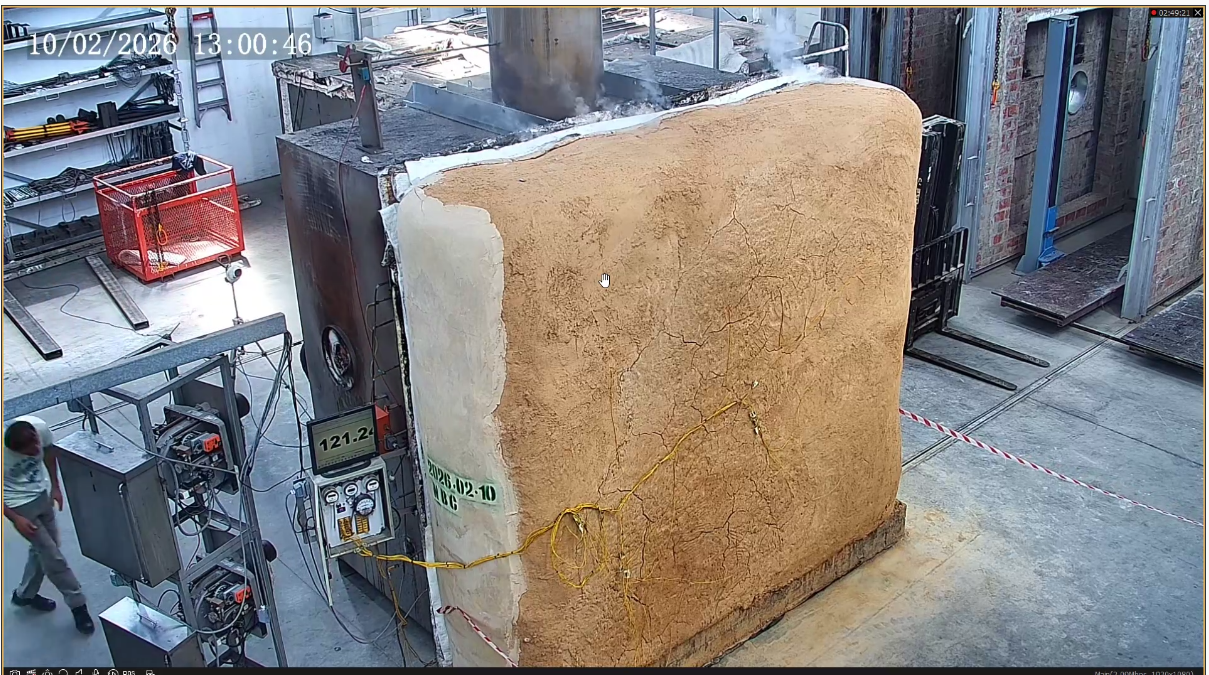
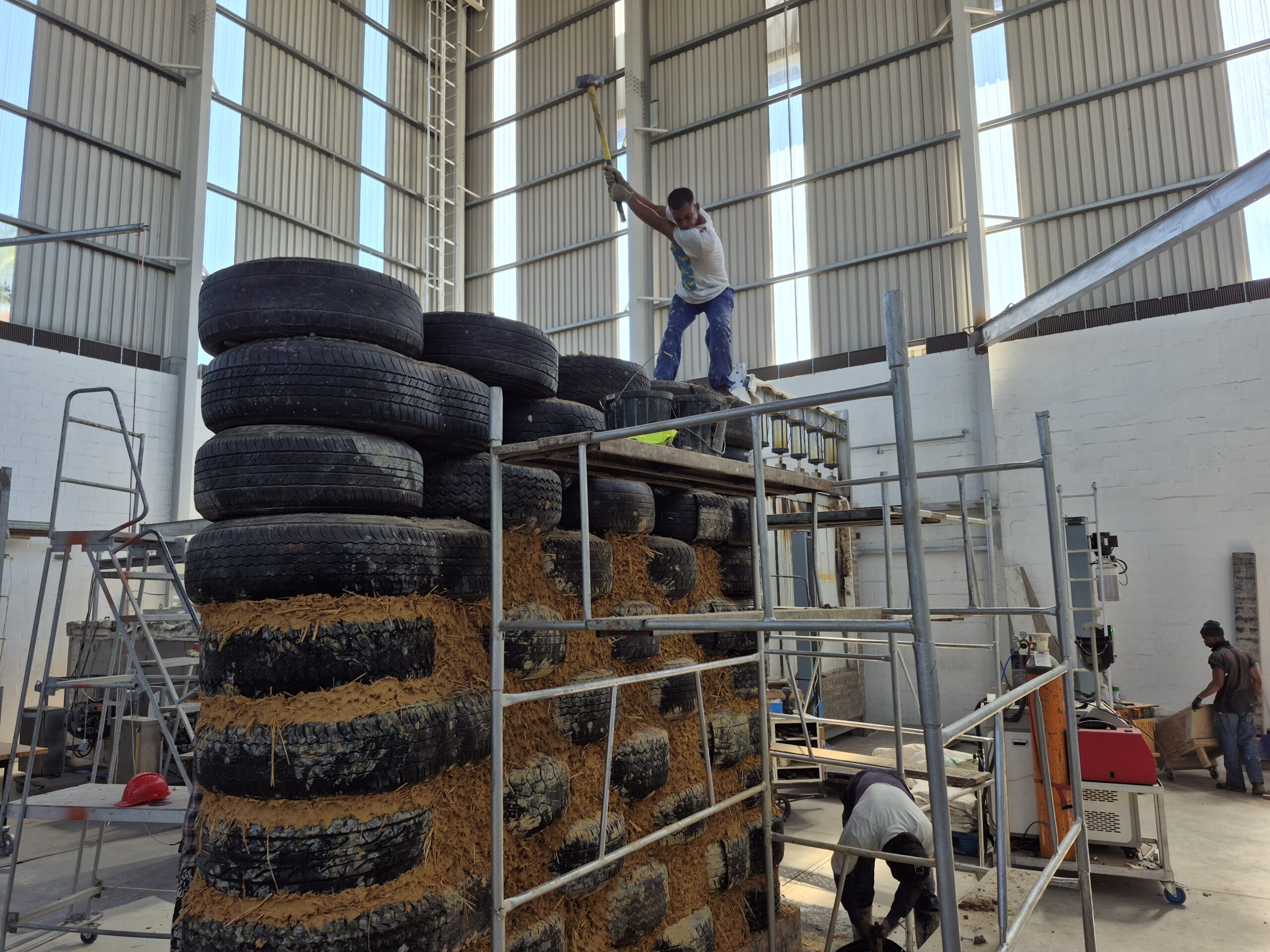
The test was a full-scale wall measuring 3,640 mm × 3,000 mm, constructed on-site at the Ignis Testing laboratory in Blackheath, Cape Town. We built the wall ourselves at the lab premises, ensuring the construction was representative of real building practice.
- Core material: 265 mm recycled tyres, G5 soil rammed to 300 mm
- Core thickness: 800 mm + 30 mm cob on both sides
- Finish layers: 30 mm cob scratch coat + 10 mm form coat + 20 mm lime plaster
- Density: ±1,800 kg/m³
- Furnace standard: EN 1363-1 (General Requirements)
- Product standard: EN 1364-1 (Non-loadbearing Walls)
Ecobricks, plastic bottles tightly packed with non-recyclable waste, were inserted between tyres as void fillers, as is common in our projects.

What happened during the test
The furnace temperature followed the standard EN fire curve, reaching over 1,000°C by the end of the test. The wall’s behaviour unfolded in distinct phases:
Within the first 5 minutes, sections of the lime plaster delaminated and fell into the furnace, an expected behaviour for lime under rapid thermal shock. However, this did not constitute a failure under the integrity criteria.
Cracks appeared in the cob layer progressively from around 12 minutes onwards. Small areas of exposed tyre rubber, approximately 100 mm × 100 mm, became visible to the furnace at around 81 minutes, with a second exposed area appearing at 88 minutes. Localised flaming at these exposed areas continued until the test was terminated.
Significantly, throughout the entire 121 minutes, the unexposed face of the wall remained at ambient temperature. The average unexposed surface temperature never exceeded 26°C — compared to an allowable average of 171°C and a maximum of 211°C. The thermal mass of the earth-filled tyre wall absorbed an enormous amount of energy while transmitting virtually none to the other side.
The test was terminated at 121 minutes because the required rating had been comprehensively demonstrated.
Why this is significant
Building code approvals for tyre construction globally have, until now, relied on engineering equivalence arguments, professional sign-off, or simply the 30-year empirical track record of Earthships in New Mexico. While individual plaster systems carry their own fire ratings, no jurisdiction has been able to point to a standardised laboratory fire rating for the full rammed-earth tyre wall assembly.
Tyre wall buildings now have a formal laboratory result to reference: a certified 120-minute rating under EN 1363-1 and EN 1364-1, European standards recognised across South Africa, the UK, and much of the world. The rating is four times the minimum 30-minute requirement, and matches or exceeds ratings commonly achieved by 200 mm concrete masonry units.
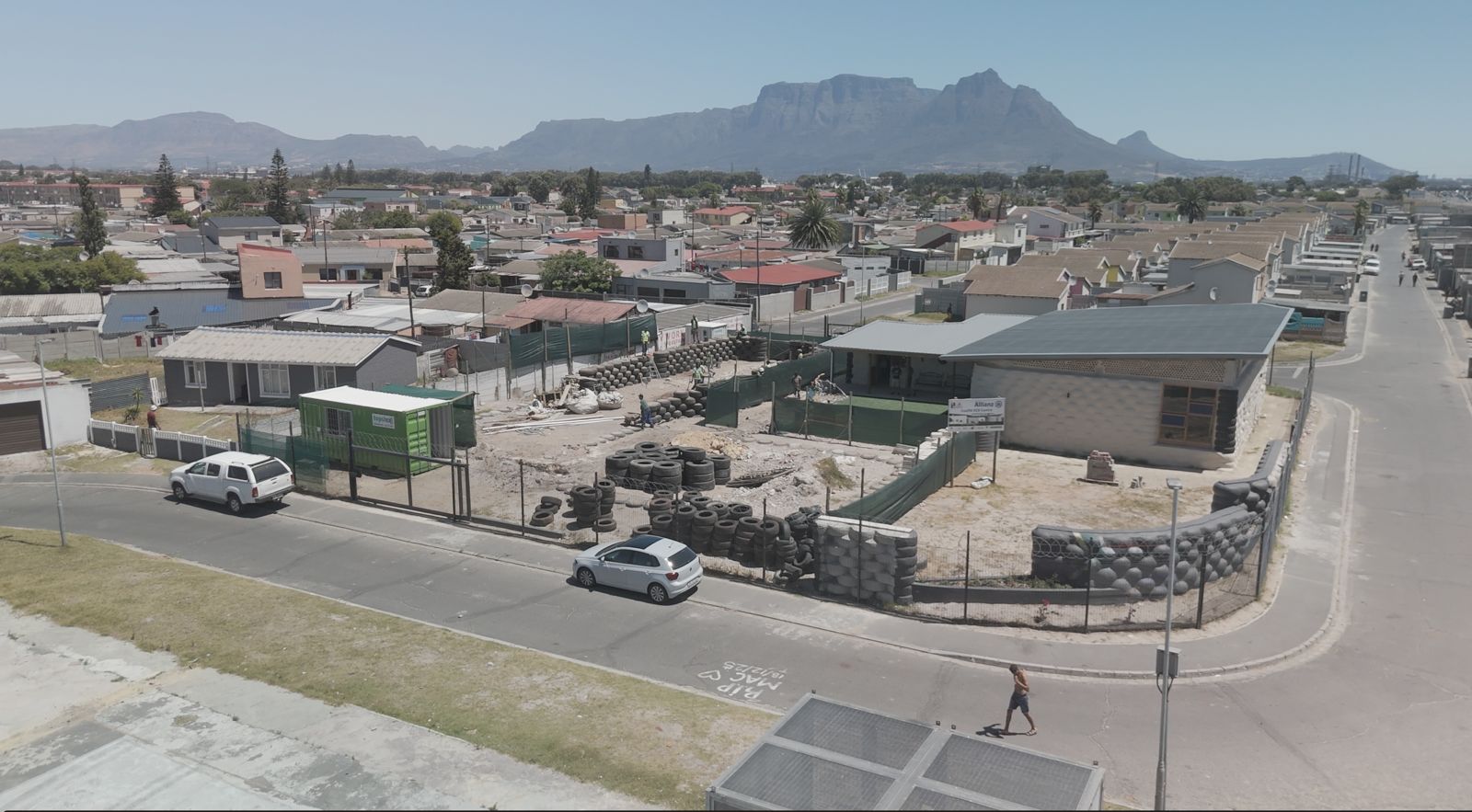
We are currently building the Heideveld Edu-Hub, a multi-classroom Montessori ECD centre in Cape Town that will use approximately 5,000 rammed-earth tyres with a tyre width of 265 mm, compacting to 300 mm in its walls. Commissioning this test is part of our commitment to ensure that tyre wall construction can be accepted into the mainstream and advance the cause of sustainable building.
For natural builders, earthship practitioners, and sustainable housing advocates worldwide, this result is a landmark. It validates what builders have long argued from first principles: that a tyre wall, plastered in cob and lime, is a fire-resistant wall.
Got questions about the test?
Since we published these results, a number of questions have come up about off-gassing, leaching, and thermal performance. We’ve addressed them in a follow-up post.
A note for planners and engineers: The test was conducted under EN 1364-1, which covers non-loadbearing walls, because no structural load was applied during the test itself. The wall as designed and built is load-bearing. The test engineers noted that given the 900 mm wall thickness, of which more than half remained unaffected after a 120-minute fire, load-bearing capacity can reasonably be assumed to be maintained. Projects using this result for planning or building consent purposes should confirm with their structural engineer that the tested assembly matches their specific design.
- Test date: 10 February 2026
- Report issued: 9 March 2026
- Testing laboratory: Ignis Testing, Cape Town
- Time rating achieved: 120 min
- Rating required: 30 min, exceeded by a factor of 4×
- Wall thickness: ±900 mm, tyres + cob + lime plaster, both sides